9:00 am - 6:00 pm - Mon - Fri
-
-
-
-
No 73, New NGGO Colony, 4th Cross Street, Adambakkam, Chennai - 600088
9:00 am - 6:00 pm - Mon - Fri
No 73, New NGGO Colony, 4th Cross Street, Adambakkam, Chennai - 600088
DEC
Key takeaways
•Google Ads, a type of PPC, offers quick ROI for short-term goals but stops once the ad budget is over, while SEO takes time but delivers sustainable, long-term returns and brand visibility.
•Google ads performance depends on ad quality, bid amount, time frame, and budget.
•Google ads can complement SEO, but they’re not a part of SEO
•SEO is a long-term strategy that drives organic traffic for a long period and is best for business that wants to build long-term brand value and authority.
Table of Contents:
1. Google Ads vs SEO: Which is better for your business?
2. What does bidding mean in Google Ads?
3. Factors on which Google ad performance depends
4. Types of Google Ads
5. Which type of Google ad will be best for your business?
6. Key factors that SEO depends on
7. Google ads vs SEO: which brings better ROI?
8. Google ads vs SEO
9. Frequently Asked Questions
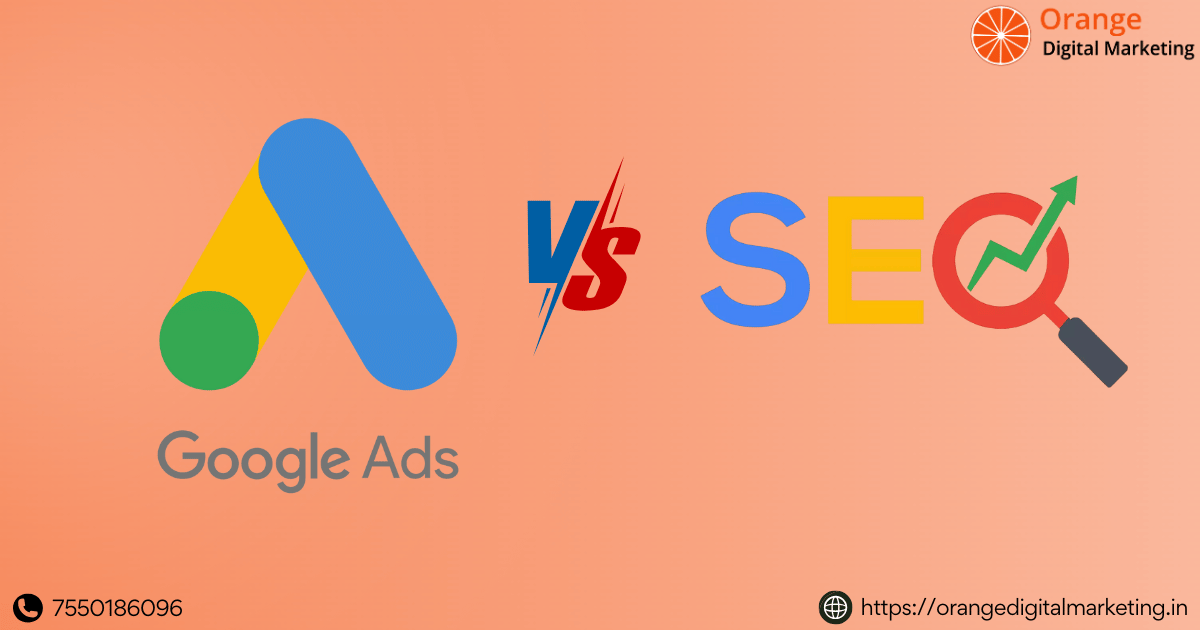
When it comes to online marketing, one of the most common debates is Google Ads vs SEO. Both have their unique strengths and work in different ways to attract customers. But choosing the right one for your business depends on your goals, timeline, and budget.
In this blog, we'll help you understand the key differences in the SEO vs Google Ads battle and guide you toward a smarter marketing decision.
PPC (Pay-Per-Click) is a broad advertising model, and Google Ads is one of the most popular platforms that uses this model.
1.PPC (Pay-Per-Click) = The advertising model where you pay each time someone clicks your ad.
2.Google Ads = A platform that uses the Pay per Click model to show ads on Google Search, YouTube, and other partner sites.
So, when people say "PPC vs SEO", they usually mean "Google ads vs PPC", but PPC also includes other platforms such as Meta Ads (Instagram + Facebook ads), LinkedIn ads, and Amazon sponsored ads.
The pay-per-click model is completely based on keywords (It's just the words you type when you're searching for something, for example: best tea shop near me. Here, tea shop is the keyword). These ads appear only when someone searches a keyword related to the product or service being advertised.
Let's say you run a business that sells custom-made sneakers. You create a Google Ads campaign targeting the keyword "custom sneakers online."
Now, when someone types the phrase "custom sneakers" or phrases related to it into Google, your ad may appear in the first position of the search results page. If the user, who is in need of your product or service, clicks on your ad, you pay Google a small fee, hence the name "pay-per-click."
Flat-rate models: In this model, the advertiser pays a fixed amount for each click, irrespective of how competitive the keyword is.
Example:
Bid-based model: In this model, advertisers bid against each other to show their ads. The one with the best combination of bid amount and ad quality gets the top spot.
Example: Google ads
Here, an advertiser is the person or business that wants to run ads. A publisher, on the other hand, is the platform where those ads are shown.
In a Google Ads campaign for custom sneakers:
1.The sneaker business is the advertiser.
2.Google is the publisher.
As mentioned earlier, Google ads (a type of bid-based model) depend on bid amount and ad quality.
Bidding is the amount of money (bid amount) you're willing to pay when someone clicks on your ad for a specific keyword. If you're targeting the keyword "custom sneakers", the amount you're ready to pay per click is your bid.
For example, you're running a Google Ad for your custom sneaker business.
You choose the keyword: "custom sneakers”. You set a maximum bid of ₹40.
This means:
You are willing to pay up to ₹40 if someone searches 'custom sneakers' and clicks my ad. But you're not guaranteed to pay ₹40. You might end up paying ₹25 or ₹30, depending on:
1.How many other advertisers are bidding on the same keyword
2.How good your ad is (Google's ad quality score)
If another brand bids ₹50, but your ad is better (more relevant), you can still appear above them, and maybe pay less.
Bidding is the amount you're ready to pay per click for a keyword like "custom sneakers," but your final cost and position on the SERP page also depend on your ad's quality.
Google ad performance depends on:
This is the maximum amount you're willing to pay for a click on your ad. It determines how competitive your ad is in the auction. The higher your bid (within your budget), the better your chances of ranking higher in the SERP pages.
Google doesn't only look at how much you're bidding; it also evaluates how good your ad is. Ad quality includes:
1.Headlines: Up to 30 characters each, with a maximum of 5 headlines
2.Descriptions: Up to 90 characters each, with a maximum of 15 descriptions
3.Other factors include ad relevance, landing page experience, and expected click-through rate (CTR)
A high-quality ad can outperform a higher-bid ad if it's more relevant and useful to the user.
Budget is the total amount you're willing to spend. Time frame is the duration of your ad campaign. Together, these control how often your ad appears and how long it stays visible to your target audience.
Example: Google ad campaign for custom sneakers
Let's say you're running an ad to promote your custom sneakers.
Scenario 1: You run the ad for 1 day with a budget of ₹500
Scenario 2: You run the ad for 7 days, spending ₹500 per day (₹3,500 total)
Will the number of leads you get in one day from Scenario 1 be the same as the leads from a single day within Scenario 2?
No. Here's why:
In a one-day campaign, you're depending on immediate reactions. But most people don't click the first time they see an ad.
In a longer campaign (Scenario 2), your ad appears multiple times to the same user. This repeated exposure increases trust and the likelihood of them clicking later.
More visibility over time means better chances of getting leads.
So, even with the same daily budget, running the ad over multiple days gives better performance due to repeated impressions and better user recall.
At the end,
1.Bid amount – how much you're willing to pay per click
2.Ad quality – how relevant and appealing your ad is
3.Budget and time frame – how much you spend and how long the ad runs
4.Type of ad you run
1.Search Ads: This is a text-based ad that appears on SERP when users search with relevant keywords.
2.Display Ads: Image or banner ads shown across Google's partner websites, apps, and Gmail to visually attract users.
3.Video Ads: Ads that appear before, during, or after YouTube videos to capture attention through motion and sound.
4.Shopping Ads: Product-based ads showing product images, price, and store name directly in search results.
5.App Ads: Automated ads that promote mobile apps across Google Search, Play Store, YouTube, and Display Network.
6.Smart Ads: Automated, goal-based ads that use machine learning to manage bidding, targeting, and ad delivery.
7.Performance Max Campaign: All-in-one automated campaign that runs across all Google platforms to maximize conversions based on your goals.
8.Discovery Ads: Visually rich ads shown on YouTube Home, Gmail, and Discover feed to reach people during moments of browsing.
Which type of Google ad is best for your business depends on your goals, budget, and audience. For example, if you're selling custom sneakers online, Search Ads and Shopping Ads work best to drive direct sales, while Display and Video Ads help build brand awareness.
SEO (Search Engine Optimization) is the technique of optimizing a website's content, structure, and technical elements to increase its ranking position on search engine results pages (SERPs). It involves using targeted keywords, improving site speed, ensuring mobile-friendliness, creating quality backlinks to drive traffic from other authority sites, and following search engine guidelines to drive organic (non-paid) traffic.
SEO has three important parts: On-page, Off-page, and technical SEO
These three areas of SEO apply to all websites, but how we implement them depends on the type of industry.
For example, On-Page SEO is done for every website. But a marketing agency may target keywords like "SEO," while a restaurant may use "best restaurants in Chennai." The steps are the same, but the strategy and content are personalized for each industry.
This is a common question, especially because Google Ads can bring traffic to your website, just like SEO does. However, the answer is no, Google Ads is not a part of SEO.
SEO focuses on organic (non-paid) traffic by optimizing your website features to rank higher on search engines. On the other hand, Google Ad is a paid advertising platform (part of PPC – Pay-Per-Click) where you pay to appear in search results. While Google Ads can complement SEO by bringing quick visibility, it is not considered an off-page SEO technique or a part of SEO strategy.
Example: We are optimizing a webpage for the keyword "SEO Services".
1.The content must be high-quality, relevant, and informative.
2.Keywords like "SEO services" should be used naturally, placed in titles, subheadings, meta descriptions, and throughout the content without keyword stuffing.
3.Internal links should be interlinked to relevant website pages within the website for better crawlability.
4.Optimizing the technical features of the website in align with search engine criteria.
1.Build high-quality backlinks by creating blog content around related search terms. For example, writing articles on "PPC vs Google Ads" or "SEO vs PPC", which have high search volume, and posting them on relevant sites.
Pros of SEO:
2.Drives organic traffic: Attracts visitors without paying for each click.
3.Delivers long-term results: Unlike ads, SEO benefits grow over time.
It is a multifaceted answer.
•Google Ads provides quick ROI – Ideal for short-term results like promotions, product launches, or time-sensitive offers.
•SEO offers long-term ROI – Once your website ranks organically, it continues to bring traffic without paying per click.
•Google Ads stops when the budget ends – No more traffic once your daily/monthly ad spend runs out.
•SEO builds brand trust and authority – Organic listings are more trusted by users, leading to better conversion over time.
Best ROI comes from combining both – Use Google Ads for immediate visibility and SEO for sustained growth.
Both Google Ads and SEO are used to bring traffic to your website, but they work in different ways and serve different goals.
1.Google Ads gives quick results. As soon as you run the ad, your website appears in the first position of the search results. But once your ad budget runs out, the visibility stops. It's ideal if you want immediate leads or sales.
2.SEO (Search Engine Optimization) takes a long time, but it's a long-term strategy. When done right, your website will appear on top of search results without paying for every click, and it will stay there longer, bringing ongoing traffic.
Each performance depends on certain factors, as mentioned earlier.
In the end, the debate between SEO and Google Ads settles at a middle ground; it all depends on your business goals, timeline, and ad budget.

1. Are Google Ads free or paid?
Google Ads is a bid-based platform that operates on a Pay-Per-Click (PPC) model, meaning you're charged only when someone clicks your ad. Although account creation and ad setup are free, showing your ads to users requires a budget. The cost per click depends on your target keywords, competition, and bid strategy.
2. How much do Google Ads cost per month?
There is no fixed monthly cost for Google Ads. Your spending depends on your industry, goals, competition, and targeting. Some small businesses start with ₹5,000 to ₹15,000 per month, while highly competitive industries might need ₹50,000 or more. Google Ads allows flexible budgeting, so you can set daily or monthly limits based on your requirements.
3. What is the difference between PPC and Google Ads?
PPC (Pay-Per-Click) is a digital advertising model where advertisers pay only when someone clicks on their ads. Google Ads is a platform that allows you to run PPC ads on Google Search, YouTube, and partner websites. All Google Ads campaigns follow the PPC model, but PPC as a strategy can also be used on other platforms like Facebook, Bing, and Instagram.
4. Is PPC better than Google Ads?
PPC is not separate from Google Ads; it's the model that Google Ads uses. Google Ads is one of the most popular PPC platforms. So, asking whether PPC is better than Google Ads is like comparing a method to a tool. You use Google Ads to run PPC campaigns on Google's network.
5. Which is more effective: PPC or SEO?
PPC gives instant traffic and visibility, making it ideal for short-term goals. SEO, on the other hand, builds organic visibility and long-term credibility. While PPC offers immediate results, SEO brings sustainable traffic. For the best results, combining both often yields the highest ROI.
Factors on which Google ad performance depends
I'm the SEO Manager at Orange Digital Marketing. with a wealth of experience, I Optimize content based on an SEO perspective and help get brands to the top of the search engine rankings. I love to contribute content and share insights that create an impact on businesses using my digital strategies. I like to present content that is valuable and easily understood by the users.