9:00 am - 6:00 pm - Mon - Fri
-
-
-
-
No 73, New NGGO Colony, 4th Cross Street, Adambakkam, Chennai - 600088
9:00 am - 6:00 pm - Mon - Fri
No 73, New NGGO Colony, 4th Cross Street, Adambakkam, Chennai - 600088
DEC
Quick Summary
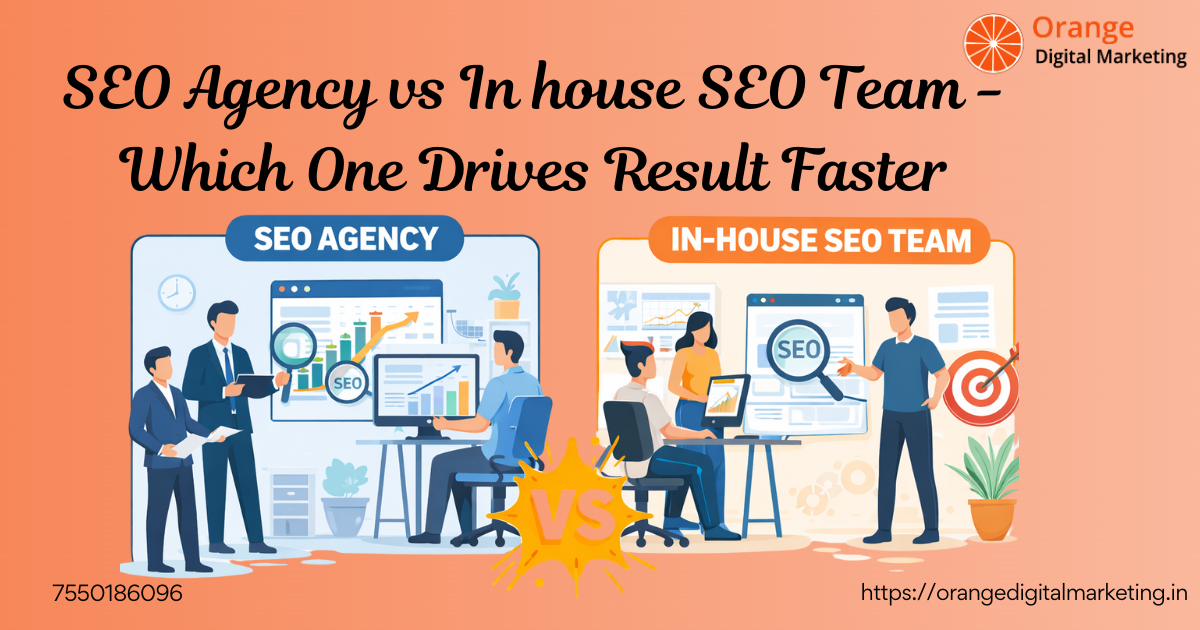
• An SEO Agency vs In-House SEO Team comparison often comes down to execution speed, control, and resource flexibility.
• Agencies deliver faster technical fixes, audits, and scalable link building because they already have systems and expertise in place.
• In-house SEO teams move faster when product or content changes require immediate approval and execution.
•?Most high-growth companies succeed with a hybrid model, combining agency agility with in-house control.
In this detailed guide, we’ll break down the SEO Agency vs In-House SEO Team debate through the lens of execution speed, scalability, and real-world performance. You’ll learn what affects SEO velocity, which model gets you results faster, and how a hybrid structure can combine the best of both worlds.
Before deciding which model is faster, you need to define what “fast SEO results” actually mean.
In SEO, “speed” doesn’t mean overnight rankings — it means how quickly your website starts showing upward momentum in metrics like:
• Technical health improvements (crawlability, site speed, indexation)
• Keyword visibility and impression growth
• Content publication velocity
• Consistent link acquisition and brand mentions
• Conversions from organic traffic
In simple terms, the speed of SEO is driven by how fast your team can implement recommendations — not just identify them.
That’s where the biggest difference between an SEO Agency and an In-House SEO Team lies: execution velocity.
Criteria | SEO Agency | In House SEO Team | Impact on Speed |
|---|---|---|---|
Setup Time | Ready to start immediately | Requires hiring & onboarding | Agency advantage |
Expertise | Specialized experts in technical SEO, content, and outreach | Smaller team, broader roles | Agency advantage |
Execution Speed | High — multiple specialists working in parallel | Moderate — depends on internal approvals | Agency advantage |
Brand Knowledge | Needs time to learn your brand | Deep understanding from day one | In-house advantage |
Tooling & Resources | Already owns enterprise-level SEO tools | May require procurement | Agency advantage |
Control & Oversight | External management required | Full internal control | In-house advantage |
Scalability | High — can scale across campaigns easily | Limited by headcount | Agency advantage |
Knowledge Retention | Depends on contract and continuity | Knowledge stays internal | In-house advantage |
1.
You Need Immediate Execution
Agencies
have complete SEO ecosystems — strategists, content writers, technical SEOs,
and link builders — all working together. You won’t have to wait months to
recruit, onboard, or train a team.
2.
You Want Breadth of Expertise
Most
agencies employ subject-matter experts across multiple SEO areas: technical,
content, UX, and analytics. This allows them to handle audits, site fixes, and
link-building simultaneously — accelerating your SEO momentum.
3.
You Need to Scale Quickly
If
your company plans to produce dozens of optimized articles or secure hundreds
of backlinks in a short timeframe, an agency’s scalable production model
delivers that bandwidth instantly.
4.
You Lack Mature SEO Processes
Agencies
thrive on process. From keyword mapping to content briefs to outreach
frameworks — everything runs on proven playbooks that have worked across
industries. This ensures faster deployment and measurable results.
5.
You’re Entering Competitive Markets
Agencies understand competitive SERPs. They have access to premium SEO tools and historical benchmark data, allowing them to identify ranking gaps and build authority faster than an inexperienced internal team.
Pro
Tip:
Choose an agency with a track record in your specific niche — whether SaaS,
healthcare, eCommerce, or B2B — to cut your learning curve in half.
While
agencies can hit the ground running, an in-house SEO team often wins in speed
once the foundation is set — especially in product-driven organizations.
1.
Immediate Control Over Implementation
In-house
SEOs can make CMS or technical changes directly, without waiting for agency
approvals or scope clarifications. This is crucial for agile, iterative SEO
work.
2.
Deeper Brand and Audience Understanding
No
external team can match the brand intuition of an in-house marketer. They know
your tone, target persona, and seasonal business cycles — making it easier to
align SEO content with brand storytelling.
3.
Cross-Functional Collaboration
In-house
SEOs can quickly coordinate with content writers, UX designers, and developers
— something agencies often struggle with due to communication barriers.
4.
Long-Term Consistency
An internal SEO team is more invested in your company’s mission, ensuring consistent execution and ongoing optimization even after initial wins fade.
5. Cost Efficiency Over Time
While hiring an agency can be faster initially, long-term in-house SEO is usually more cost-effective. Salaries replace recurring retainers, and institutional knowledge builds up internally.
For
SaaS and tech startups, time is everything. Markets move fast, competitors
launch features weekly, and search trends shift rapidly. You need an SEO setup
that’s nimble, data-driven, and scalable — and that’s where the hybrid model
shines.
Instead
of choosing strictly between an SEO Agency vs In-House SEO Team, the hybrid
model combines agency execution speed with in-house strategic control.
Here’s
what a hybrid SEO structure looks like in practice:
Agency
Handles:
·??????
Technical
SEO audits and site optimization
·??????
Keyword
research and content planning
·??????
Large-scale
content production (blogs, landing pages, guides)
·??????
Link-building
and digital PR campaigns
In-House
Team Handles:
·??????
Brand
tone, content approval, and messaging consistency
·??????
Product-led
content and updates
·??????
Integration
with growth marketing, UX, and product teams
·??????
Performance
tracking and ongoing optimization
This split allows startups to launch SEO fast with agency support, while keeping control over the brand narrative and product direction internally.
1. Immediate Access to Resources
You get an entire SEO department on day one — strategists, writers, link builders, and analysts. No waiting months to hire talent.
While the agency runs audits and fixes, your in-house marketer focuses on approvals and analytics.
2. Scalable Production
For fast-moving SaaS companies, you might need to publish 50+ content assets per month — including feature pages, blog posts, and knowledge base articles.
Agencies can ramp up content velocity without sacrificing quality.
3. Real-Time Brand Feedback
The in-house SEO manager ensures that every piece of content aligns with product messaging, positioning, and customer intent — something an external agency can’t do as precisely.
4. Faster Decision-Making
Hybrid setups eliminate bottlenecks. The agency executes tasks quickly, and the internal team provides instant feedback, reducing back-and-forth delays.
5. Sustainable Long-Term Growth
Once the foundation is built, the in-house team can take over maintenance and experimentation, ensuring your SEO continues compounding even if you phase out the agency.
Example:
A B2B SaaS start-up working with an agency for 6 months can go from zero to 50+ ranked pages, while the in-house SEO lead ensures product pages convert visitors effectively.
Speed Factors: What Actually Determines Fast SEO Results
No matter which model you choose — agency, in-house, or hybrid — SEO speed depends on how efficiently strategy turns into implementation.
1. Implementation Lag
This is the time between an SEO recommendation and its live deployment on your site. Agencies often face friction from internal approvals, while in-house teams may move faster once embedded in product workflows.
Pro Tip:
Adopt a clear SLA (Service Level Agreement) between your agency and internal devs — e.g., “SEO recommendations must go live within 14 days of sign-off.”
2. Technical Health
A clean, fast, and indexable site amplifies all your SEO efforts. Agencies usually fix technical issues faster thanks to tools like Screaming Frog, Ahrefs, and Sitebulb — but internal dev support is key for sustained technical hygiene.
3. Content Velocity
The faster you publish optimized, intent-driven content, the faster you’ll gain traction.
Agencies have the manpower to produce content at scale, but in-house editors maintain tone and accuracy. Together, they build momentum.
4. Link-Building Momentum
Links remain a top-ranking factor. Agencies already have outreach networks and relationships with publishers, meaning they can start earning backlinks immediately.
Meanwhile, internal marketers can support link-building through co-marketing partnerships and PR.
5. Decision-Making Efficiency
The biggest speed killer in SEO is indecision. Whether approvals get stuck with legal, design, or product teams — every delay adds up.
Streamlined communication between your agency and internal SEO lead ensures that every change gets prioritized and executed on schedule.
To determine whether your SEO Agency vs In-House SEO Team setup is performing, track these metrics monthly:
? ? ? • Time to Implementation: Average days between audit and execution.
? ? ? • Keyword Velocity: Rate at which target keywords improve in rankings.
? ? ? • Content Output: Number of optimized pages published per month.
? ? ? • Link Velocity: Number of quality backlinks earned per quarter.
? ? ? • Organic Traffic Growth: Increases in impressions, clicks, and CTR.
? ? ? • Conversion Lag: Time between traffic spike and first conversion.
If you’re a SaaS start-up, pay special attention to conversion lag — ranking faster doesn’t always mean more MQLs or signups immediately. Organic leads often mature over multiple touchpoints.
Even the best setup can stumble if execution isn’t managed well. Avoid these common pitfalls that sabotage SEO velocity:
1. Expecting Overnight Rankings
SEO is a long game. Even with an agency, expect visible traction in 3–6 months, not weeks.
Google rewards authority, consistency, and user trust — not shortcuts.
2. Over-Focusing on Keywords Instead of Intent
Targeting keywords without understanding search intent wastes resources. Focus on solving user problems first; rankings follow naturally.
3. Ignoring Technical Debt
A fancy blog won’t perform if your site has crawl errors, duplicate content, or slow load times.
Fix technical SEO first, then scale content.
4. Poor Collaboration Between Agency and Team
Communication breakdowns cause duplicated work and delays. Schedule recurring syncs, share dashboards, and agree on ownership boundaries early.
5. Underfunding SEO
Whether agency or in-house, underinvesting in content, tools, or developers slows down results.
Fast SEO needs proper resources — treat it like a product, not a project.
The debate of SEO Agency vs In-House SEO Team isn’t about which is better — it’s about timing, maturity, and business goals.
• SEO Agencies bring speed, expertise, and scalability — perfect for startups that need traction fast.
• In-House SEO Teams bring ownership, alignment, and long-term stability — ideal for sustained brand-led growth.
• Hybrid Models merge the best of both worlds — agency velocity with in-house precision.
In today’s SaaS landscape, the fastest results come from collaboration, not competition. Build a flexible SEO structure that adapts as you grow, measure execution speed relentlessly, and keep your strategy aligned with business goals.
Because in the end, SEO success isn’t about shortcuts — it’s about momentum, focus, and consistency.
1. Which drives results faster — SEO Agency or In-House SEO Team?
An SEO agency usually delivers results faster in the short term. They have ready-made teams, established workflows, and advanced tools to execute audits, technical fixes, and link-building campaigns immediately.
However, in-house teams move faster once embedded in company workflows because they can make real-time product or CMS changes without external dependencies.
2. Is an SEO agency more cost-effective than building a team?
In the short term, yes. An agency offers access to a full SEO department for the cost of one or two hires.
Long term, however, an in-house SEO team becomes more efficient as they gain brand knowledge and retain internal expertise.
3. How soon can a SaaS company see SEO results?
Expect to see initial ranking improvements within 3–6 months, and more meaningful traffic and conversion gains between 6–12 months.
That said, the hybrid model often achieves the fastest early traction — combining agency execution with internal brand oversight.
4. Can both models work together?
Absolutely. The hybrid SEO model is increasingly the norm among fast-scaling startups. Agencies handle scalable production and outreach, while in-house teams ensure alignment with brand voice, UX, and growth strategy.
5. Which model is better for startups?
For early-stage SaaS startups, agencies are ideal for quick wins and foundational setup.
As the company matures, transitioning to an in-house SEO lead (supported by external partners) ensures long-term cost efficiency and better brand control.
Decision Framework: How to Choose the Right SEO Model
When weighing an SEO Agency vs In-House SEO Team, ask these key questions:
1. Speed or Control — which matters more right now?
If your goal is to launch fast and test early, go agency-first. If you need tighter messaging control, lean in-house.
2. Do you already have internal marketing or dev bandwidth?
If your engineering or marketing teams are stretched, external SEO support will deliver results faster.
3. How complex is your SEO ecosystem?
SaaS companies with dynamic products and frequent feature releases benefit from internal teams for faster integration.
4. What’s your budget horizon?
Agencies are higher in cost upfront but require no hiring delays. In-house teams need salaries and tools but build long-term equity.
5. Can you build a hybrid setup?
If you can invest in both — do it. The hybrid model consistently outperforms either approach alone in speed, scalability, and resilience.
Case Example: How a SaaS Startup Grew Organic Leads 4x Faster
A mid-stage SaaS firm partnered with an SEO agency for six months while hiring its first in-house SEO lead.
• The agency focused on high-volume blog content, link-building, and technical audits.
• The in-house SEO aligned content with customer pain points and product updates.
Within six months, the company saw:
• 60% increase in organic traffic
• 4x more inbound leads
• 70+ new ranking keywords
By month seven, the startup scaled down the agency retainer and maintained growth internally — proving that a hybrid model can deliver both speed and sustainability.
I'm the SEO Manager at Orange Digital Marketing. with a wealth of experience, I Optimize content based on an SEO perspective and help get brands to the top of the search engine rankings. I love to contribute content and share insights that create an impact on businesses using my digital strategies. I like to present content that is valuable and easily understood by the users.