9:00 am - 6:00 pm - Mon - Fri
-
-
-
-
No 73, New NGGO Colony, 4th Cross Street, Adambakkam, Chennai - 600088
9:00 am - 6:00 pm - Mon - Fri
No 73, New NGGO Colony, 4th Cross Street, Adambakkam, Chennai - 600088
JUL
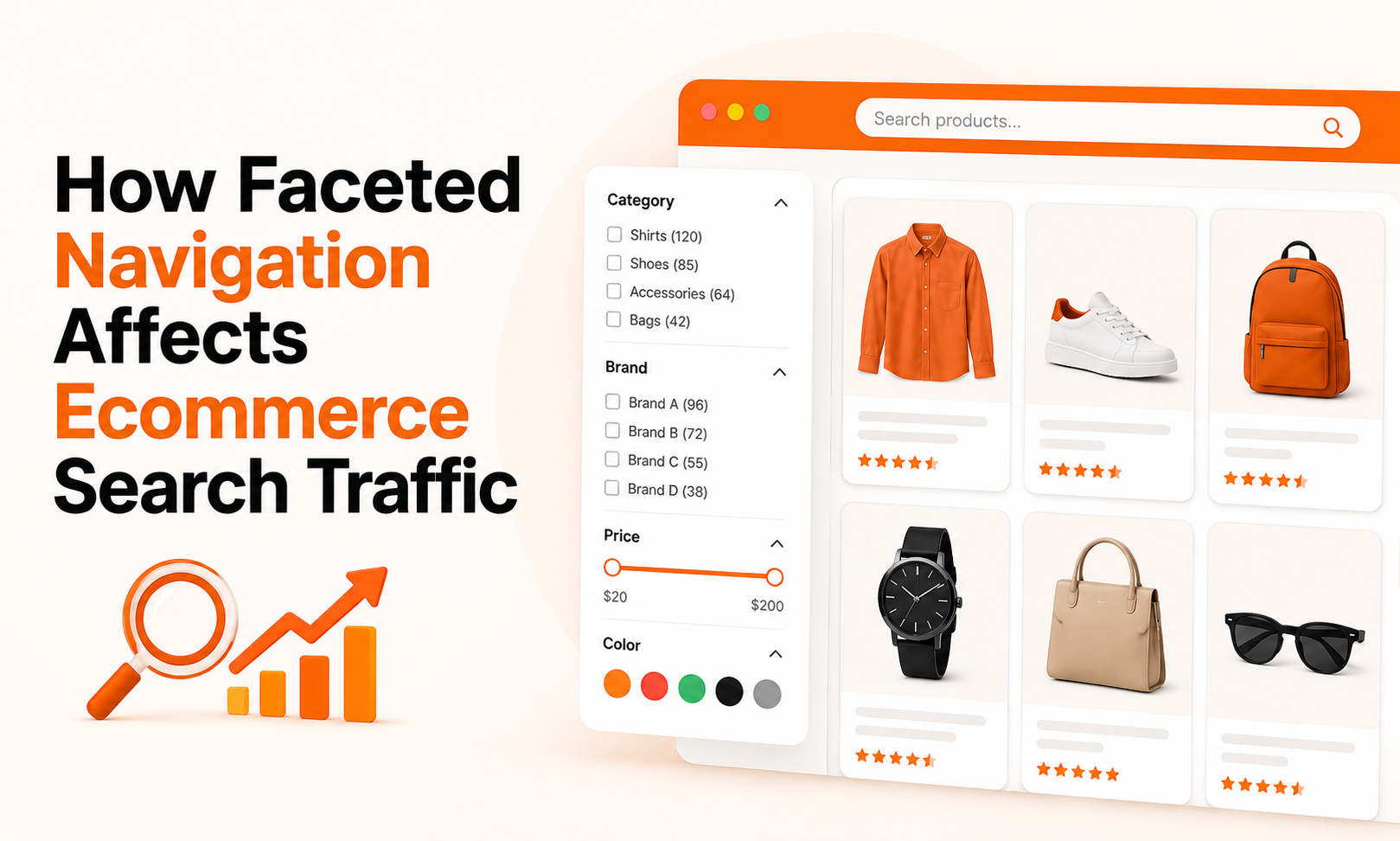
Faceted navigation helps shoppers turn a huge product catalogue into a manageable shortlist. A customer can filter shoes by size, colour, brand, price and material instead of scrolling through hundreds of irrelevant products. For people, that is a clear improvement.
For search engines, the same feature can create an enormous number of URLs. Six filters with ten possible values each can theoretically produce one million combinations before you add pagination, sorting and tracking parameters. Most ecommerce sites do not need even a small fraction of those combinations in search results.
This is where faceted navigation becomes an SEO decision rather than a design feature. You need to preserve the filters that help customers and attract relevant searches while preventing low-value combinations from consuming crawl resources, entering the index or competing with important category pages.
A human-first approach gives you the right starting point. Keep a filter when it helps someone narrow a meaningful choice. Create an organic landing page when a combination answers genuine search demand. Control everything else so search engines spend more time on products and categories that deserve visibility.
Faceted navigation can behave like a corridor in which every door opens onto ten more corridors. A crawler follows one combination, discovers several additional filters and keeps finding URLs that appear new even when the products barely change.
This expanding collection is sometimes called the crawl space. In plain English, it is the total set of URLs a crawler can discover on your website. If filters create an effectively endless crawl space, search engines may spend substantial resources checking variations that offer little or no new value.
Consider a clothing category with filters for brand, colour, size, material, fit, price, availability and customer rating. The same products may appear under many different parameter orders:
/clothing?brand=acme&colour=black /clothing?colour=black&brand=acme /clothing?brand=acme&colour=black&sort=price /clothing?sort=price&colour=black&brand=acme
To a shopper, these URLs may represent one useful selection with different display settings. To a crawler, each address can look like a separate page that needs to be requested and evaluated.
Begin by mapping how your facets create URLs. Record which parameters represent meaningful product attributes and which only change presentation or session state. Sorting, grid layout, items per page, tracking codes and internal search terms rarely deserve separate crawlable URL's.
| Facet or Parameter | Typical Value to Shoppers | Recommended Search Treatment |
|---|---|---|
| Brand within a Category | Often high | Consider an indexable landing page when there is proven search demand. |
| Colour or Material | Varies by product type | Allow selected combinations only when they provide unique and lasting search value. |
| Size | Useful for shopping, often weak for search | Keep functional for users but generally prevent indexation. |
| Sort Order | Changes presentation only | Prevent crawlable URL expansion caused by sorting parameters. |
| Items per Page | Changes presentation only | Consolidate to the primary category page using canonicalization. |
| Session or Tracking ID | No content value | Exclude from internal links and canonical URLs to avoid duplicate pages. |
| Out-of-Stock Filter | Usually temporary | Keep out of search results unless it serves a long-term search intent. |
| Empty Combination | No value | Return a proper 404 Not Found response when the filter combination is invalid. |
Do not generate clickable URLs for impossible combinations. If no green leather jackets exist, disable that option or show a clear zero count before the customer selects it. This helps people avoid dead ends and stops crawlers from entering pages with no useful inventory.
Keep parameter formatting consistent. Use a fixed order for filters and prevent the same value from appearing twice. The system should treat brand=acme&colour=black and colour=black&brand=acme as one state rather than two independent URLs.
If a group of faceted URLs never needs to appear in search, you can restrict crawling through carefully tested robots.txt rules. This is most suitable when the parameter pattern is predictable and blocking it will not hide products or landing pages that search engines need to reach.
Do not treat a canonical tag as a complete crawl-control tool. A crawler normally has to request a URL before it can see the canonical, so large volumes of non-canonical facets may still consume resources. Likewise, noindex can remove pages from search, but the pages must remain crawlable long enough for that instruction to be processed.
Use server logs to see what search bots actually request. A normal crawler shows what your internal links expose, while log files reveal whether bots are spending time on URLs containing sort=, repeated filters or deep pagination. Compare crawl frequency with organic visits and conversions to identify patterns that consume resources without producing value.
Your goal is not to stop customers from filtering. It is to prevent every temporary interface state from becoming a permanent search-engine destination.
Crawling and indexing are different stages. A search engine may crawl a filtered URL to inspect it, then decide whether that page should be stored as a search result. Problems grow when thousands of near-identical facets become eligible for indexing.
This is often called index bloat. The term describes an index filled with low-value, duplicate or outdated URLs that do not deserve independent visibility. The number itself is less important than the quality of the pages included.
A category page sorted by price may contain exactly the same products as the default category, only in a different order. Filters for size 8 and size 9 may also produce almost identical selections. If every version is indexable, search engines must decide which one best represents the category.
Duplicate facet pages can also be created by technical inconsistencies. Uppercase and lowercase values, singular and plural labels, alternative parameter orders, trailing slashes and encoded characters may all produce separate addresses for the same filtered result.
A clean system needs one representative URL for each page you intentionally want in search. Unnecessary variations should either resolve to that address, canonicalise to it or remain outside the index according to a consistent rule.
Canonical tags are useful when several accessible URLs show equivalent content. The duplicate versions can point to the preferred category or facet, while the chosen page uses a self-referencing canonical. Internal links and sitemap entries should support the same URL.
However, a canonical is a hint, not a shortcut for poor architecture. If a filtered page contains a substantially different product set and receives many internal links, search engines may treat it as a separate page despite a canonical pointing elsewhere.
Be careful when combining robots.txt and noindex. If you block crawling first, search engines may never see the noindex instruction on URLs they already know. When removing existing facet pages from the index, allow crawling while the instruction is processed, then consider longer-term crawl controls once the unwanted URLs have dropped out.
Pagination needs its own logic. Page two of a category is not a duplicate of page one because it contains different products. Canonicalising every paginated URL to the first page can make deeper products harder to discover. Keep pagination crawlable when it forms an important route through the catalogue, and ensure each page points to a stable version of itself.
Audit indexed URLs by pattern rather than reviewing random examples. In Google Search Console, group known parameters and compare indexed counts with the number of facet pages you intentionally created. A site:search can reveal obvious examples, but it should not be treated as a complete index report.
Your audit should look for:
Multiple parameter orders that return the same selection.
Sort, layout and tracking variations appearing in search.
Facets with zero or very few products.
Search-result pages created by unrestricted user input.
Duplicate titles and headings across filter combinations.
Faceted URLs indexed despite being absent from your approved landing-page list.
Fix the underlying generation rules before cleaning up individual URLs. Manually changing thousands of canonicals is temporary if the platform keeps creating new variations. Standardise parameters, stop linking to duplicate orders and make invalid combinations return an appropriate status.
Facets are not automatically bad for SEO. Some of them describe exactly what people search for and can become valuable landing pages when the product selection is useful, stable and distinct.
A broad category such as “sofas” may be too general for someone looking for a “blue velvet sofa” or a “small leather sofa.” Brand, material, colour, use case and compatible model can all express meaningful intent. A curated facet page can connect that search directly to a relevant group of products.
The key word is curated. Allowing every possible combination into the index is not a landing-page strategy. It is automation without judgement.
Start with search demand, but do not stop there. A keyword tool may show that people search for a filter combination, yet the page still needs enough appropriate products to satisfy them. A landing page with one weak item, unstable stock or misleading labels will disappoint visitors even if the query has volume.
Evaluate candidate facets using four questions:
| Question | What a Strong Candidate Looks Like |
|---|---|
| Do people search for this combination? | The query has recurring search demand or clear commercial intent. |
| Is the inventory meaningful? | The page contains enough relevant products to support comparison and purchasing decisions. |
| Will the selection remain stable? | The page is unlikely to become empty due to normal inventory or stock changes. |
| Can the page add distinct value? | Its title, heading, content, and merchandising provide unique value for the specific search intent. |
Once a filter qualifies, give it a stable, readable URL. A path such as /sofas/blue-velvet/ is easier to manage and understand than a long string containing sort, display and tracking values. The exact format matters less than consistency and permanence.
The page should use a self-referencing canonical, appear in the XML sitemap and receive internal links from relevant categories, buying guides or brand pages. Breadcrumbs should show where it sits in the catalogue rather than presenting it as an isolated search result.
Write a clear title and heading that describe the actual selection. Add concise introductory copy when it helps the customer choose, but do not bury the products under generic SEO text. Product availability, filters, prices and delivery information should remain the main experience.
Avoid producing pages that differ only by one repeated keyword. “Cheap blue sofas under £500 on sale” may reflect several filters, but the wording and inventory need to make sense to a real shopper. Overoptimised combinations often look thin because they were created for search engines rather than people.
You should also prevent the approved landing page from spawning its own uncontrolled filter space. A customer may continue filtering from “blue velvet sofas,” but the resulting size, price and sort combinations do not automatically deserve indexation.
Treat indexable facets like maintained category pages. Assign ownership, review performance, update internal links and check that the promised product selection remains accurate. Quality control is what turns a filter into a durable organic asset.
Even when faceted category pages are controlled, filters can create multiple routes to the same product. A product may appear under a category path, a campaign parameter, a filtered collection and a direct canonical URL.
For example, the same item could be accessible at:
/products/waterproof-jacket/
/mens/coats/waterproof-jacket/
/outerwear?colour=black&product=waterproof-jacket
/products/waterproof-jacket/?source=filtered-category
If these URLs are all indexable, organic visibility can become fragmented. Different versions may earn impressions, clicks, backlinks and internal-link signals. Instead of building one strong search result, the site maintains several weaker candidates.
This can look like keyword cannibalisation, but the root cause is often URL duplication rather than genuinely competing content. Search engines alternate between versions because your technical and internal signals do not identify one clear destination.
Choose a permanent product URL that does not depend on the path a shopper used to find it. Category membership can change, and products often appear in several collections. A stable product address survives merchandising updates without creating a new indexable page each time.
All navigational routes should link to that preferred URL. If tracking is necessary, use parameters for analytics without changing the canonical destination. Alternate versions should redirect or canonicalise according to whether they need to remain accessible.
Category and facet pages require a different decision. Two pages can display similar products but serve different intentions. A general “running shoes” category and a curated “women's waterproof trail running shoes” page may both deserve visibility if each answers a distinct query and provides a useful selection.
Problems arise when two URLs target the same intention with only minor differences. A static landing page for “black trainers” should not compete with an indexable parameter version showing the same products. Select one representative page, point internal links to it and prevent the duplicate from becoming a separate search candidate.
Use Google Search Console to compare queries by exact page. Look for the same query producing impressions across several category, facet or product URLs. Then review whether the pages answer different needs or merely duplicate one another.
A practical consolidation process is straightforward:
Group URLs that show the same product or equivalent product selection.
Choose the page that best satisfies the intended search and customer journey.
Align canonical tags, internal links, sitemap entries and redirects with that choice.
Remove crawlable links to unnecessary parameters and sort variations.
Monitor combined impressions, clicks and revenue for the group after recrawling.
Revenue and customer behaviour should remain part of the decision. A clean URL is not automatically the right landing page if it hides useful filters or sends visitors to an unsuitable product selection. SEO is the mechanism, but the person choosing a product is the audience.
Well-managed facets make a large catalogue easier to explore without allowing temporary filter states to dominate search. They protect crawl resources, keep duplicate pages out of the index, create focused landing pages where demand exists and concentrate organic clicks on the URLs you want customers to use.
That structure also gives you a more dependable view of website traffic. Instead of interpreting fragmented visits across thousands of near-identical URLs, you can measure the categories, facets and products that genuinely attract qualified shoppers. Audit one major category first, define clear rules for its filters and then apply the proven model across the rest of your store.

Sanya is a content writer at Orange Digital Marketing with expertise in creating engaging, search-optimized content for websites and blogs. She focuses on producing informative, high-quality content backed by industry research, ensuring every article delivers value to both users and search engines.